
Ceramic Fiber Board vs Blanket vs Paper: How to Choose the Right Insulation
Choosing the right ceramic fiber insulation material is important for industrial furnace efficiency, equipment protection and installation performance. Ceramic fiber board, ceramic fiber blanket and ceramic fiber paper are designed for different insulation requirements, even though all three are used in high-temperature applications.
For industrial buyers, insulation contractors, equipment manufacturers and distributors, understanding the differences between these materials helps simplify product selection and procurement.
1. Ceramic Fiber Board vs Blanket vs Paper: Key Differences
The main differences are physical form, flexibility, mechanical properties and installation method.
- Ceramic Fiber Board: A rigid insulation panel for applications requiring dimensional stability and a defined shape.
- Ceramic Fiber Blanket: A flexible insulation material suitable for covering large surfaces and fitting around compatible irregular shapes.
- Ceramic Fiber Paper: A thin, flexible sheet commonly used for gaskets, sealing layers and narrow insulation gaps.
Product Comparison Table
| Característica | Placa de fibra cerâmica | Manta de fibra cerâmica | Papel de fibra cerâmica |
|---|---|---|---|
| Physical Form | Painel rígido | Flexible blanket roll | Thin flexible sheet |
| Flexibility | Low | High | High |
| Principal vantagem | Retenção da forma | Adaptability and coverage | Thin insulation and sealing |
| Aplicações típicas | Furnace panels and rigid linings | Furnace linings and equipment insulation | Gaskets and sealing layers |
| Instalação | Corte, ajuste e fixação | Cutting, wrapping and fixing | Cutting, layering or die-cutting |
Note: Actual performance depends on product grade, density, thickness, manufacturing process and operating conditions. Refer to the relevant technical datasheet before selecting a material.
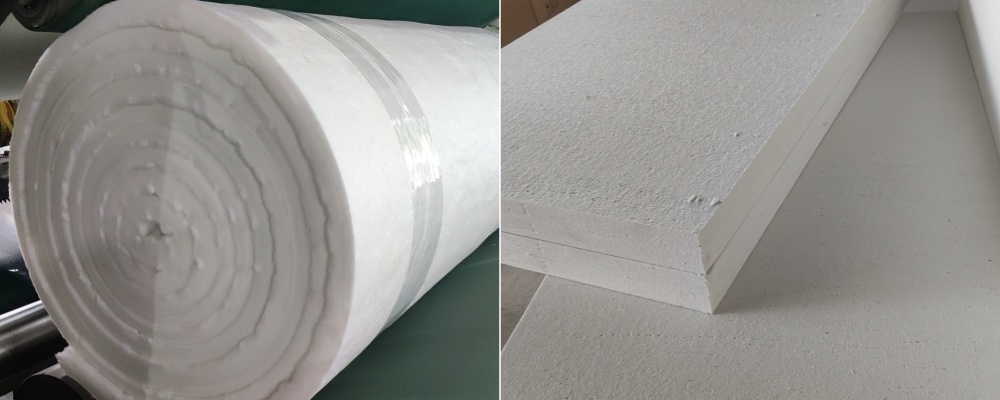
2. Ceramic Fiber Board: For Rigid Insulation Applications
Ceramic fiber board is a rigid thermal insulation product used where a defined shape and dimensional stability are required.
Common Applications
- Industrial furnace doors and access panels
- Selected kiln and furnace lining components
- Heating equipment insulation panels
- Custom-cut insulation components
Compared with a flexible blanket, ceramic fiber board is easier to use where a flat, rigid insulation surface is needed. However, its mechanical strength and suitability for contact or loading must be evaluated according to the installation design.
When sourcing ceramic fiber board for furnace insulation, buyers should confirm the required thickness, density, temperature grade, dimensions and mechanical properties.
Saiba mais sobre a Mindelun’s Ceramic Fiber Fire Barrier Board and explore suitable options for industrial insulation projects.
3. Ceramic Fiber Blanket: For Flexible Furnace Insulation
Ceramic fiber blanket is a lightweight, flexible insulation material used on large surfaces, irregular geometries and suitable multilayer insulation systems.
Common Applications
- Industrial furnace wall insulation
- Kiln lining and backup insulation
- Equipment insulation around compatible curved surfaces
- Thermal insulation for selected industrial heating systems
The flexibility of ceramic fiber blanket makes it easier to cut and fit around suitable equipment shapes. Installation generally requires an appropriate fixing or containment system. Applications involving abrasion, high-velocity gas flow or direct mechanical contact require additional evaluation.
For buyers looking for a ceramic fiber blanket supplier for industrial furnace insulation, product selection should consider operating conditions, required thickness, density and installation method.
View Mindelun’s Manta de fibra cerâmica for more product information.
4. Ceramic Fiber Paper: For Thin Insulation and Sealing
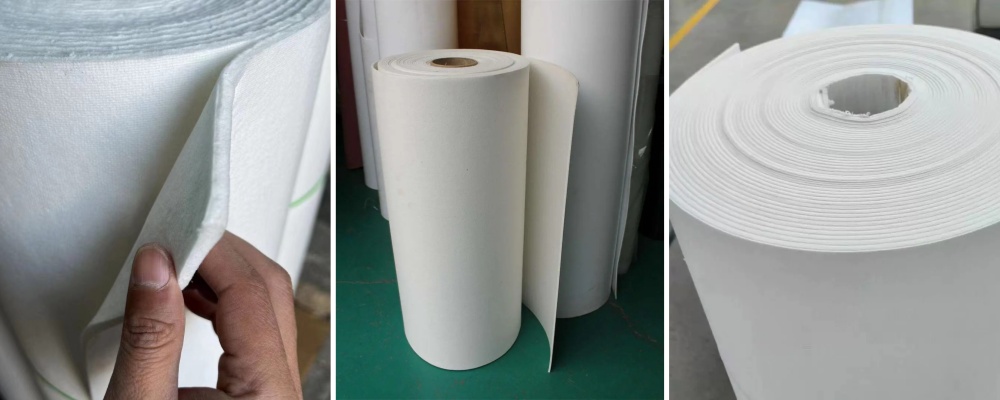
Ceramic fiber paper is a thin sheet material designed for applications where insulation or sealing is required in a limited space.
Common Applications
- Juntas para altas temperaturas
- Selected furnace door sealing assemblies
- Compatible expansion-joint systems
- Thin thermal separation layers
Ceramic fiber paper can be cut into strips, pads and gasket shapes. It is not a direct substitute for rigid board where structural support is required or for blanket where a thicker insulation layer is needed.
When selecting ceramic fiber paper for high-temperature gaskets, buyers should review thickness, handling strength, binder characteristics and actual service conditions.
Browse Produtos de fibra cerâmica Mindelun to explore available insulation materials. For an application-specific example, see our article on ceramic fiber paper for car gasket manufacturing in Indonesia.
5. Can Ceramic Fiber Board, Blanket and Paper Be Used Together?
Yes. Different ceramic fiber formats can be combined in an engineered insulation system when each material is suitable for its intended function.
For example, ceramic fiber board may be used where a rigid panel is required, ceramic fiber blanket may provide flexible insulation behind compatible lining components, and ceramic fiber paper may serve as a thin sealing layer at selected joints.
The final arrangement should consider operating temperature, thermal cycling, mechanical loads, gas flow, installation method and material compatibility. Using several products together does not automatically improve insulation performance; each layer must meet the requirements of its application.
For broader furnace insulation planning, visit Mindelun’s Isolamento de fornos industriais página.
6. How to Choose the Right Ceramic Fiber Insulation Material
Before requesting a quotation, industrial buyers should define the operating conditions and installation requirements.
Temperature and environment: Provide the continuous operating temperature, thermal cycling and exposure conditions. Classification temperature should not automatically be treated as the recommended continuous service temperature.
Dimensions and specifications: Confirm thickness, density, length, width and dimensional tolerances.
Mechanical requirements: Identify any compression, abrasion, vibration or physical contact that may affect material selection.
Installation method: Explain whether the material is intended for furnace lining, equipment insulation, gaskets or custom components.
Requisitos de aquisição: Specify estimated order quantity, packaging, delivery destination and customization needs.
Mindelun supports distributors, contractors, equipment manufacturers and industrial buyers with ceramic fiber insulation product selection and B2B quotation services.
Perguntas Frequentes
1. What is the difference between ceramic fiber board and blanket?
Ceramic fiber board is rigid and maintains a defined panel shape, while ceramic fiber blanket is flexible and adapts more easily to compatible irregular surfaces. The right choice depends on the installation design and mechanical requirements.
2. Is ceramic fiber paper the same as ceramic fiber blanket?
No. Ceramic fiber paper is a thin sheet commonly used for sealing and narrow insulation gaps. Ceramic fiber blanket is a thicker, flexible material for larger insulation areas and suitable lining systems.
3. Which ceramic fiber material is best for industrial furnace insulation?
There is no single best material for every furnace. Board may suit rigid panels, blanket may suit flexible lining systems, and paper may suit thin sealing applications. The final choice depends on operating conditions and equipment design.
4. Can ceramic fiber blanket replace ceramic fiber board?
Not in every application. Blanket does not provide the same rigidity as board and may be unsuitable where a defined rigid surface is required. Confirm suitability before making a material substitution.
5. How do I choose the correct temperature grade?
Consider continuous operating temperature, thermal cycling, atmosphere and other service conditions. Review the manufacturer’s technical datasheet and recommended operating limits before ordering.
Conclusion: Choose Ceramic Fiber Insulation by Application
Ceramic fiber board, blanket and paper serve different roles in high-temperature insulation. Board offers rigidity, blanket provides flexibility for larger or irregular surfaces, and paper is useful for thin insulation and sealing.
Matching the product format and grade to the installation requirements helps industrial buyers make informed purchasing decisions.
Looking for a ceramic fiber insulation supplier? Contact Mindelun with your application, operating temperature, required dimensions and estimated quantity. Our team can review your requirements and provide suitable product options and a quotation.
Related Products and Resources
 Portuguese
 English
 Arabic
 French
 German
 Spanish
 Russian
 Indonesian